


We’re assembling reactions to the UK Budget from online/social. Latest posts and information will appear at the bottom of this article.
To submit your views for possible inclusion, email [email protected]
Short Summary of the budget:
UK Budget 2026: Key measures for entrepreneurs and startups
- Capital Gains Tax cut for founders: New Founders’ Relief introduces a 10% CGT rate on lifetime gains of up to £10 million for eligible founders and early investors from April 2027.
- Better employee share options: New EMI2 scheme allows employees to receive share options worth up to £120,000, alongside existing EMI options.
- More startup and scaleup funding: British Business Bank capacity increases to £30.6 billion, including £1.4 billion in additional equity investment capacity and £450 million for venture debt.
- AI investment: Additional £60 million for direct investment in promising UK AI companies, plus £80 million for sovereign AI R&D procurement.
- Simpler tax incentives: Reduced paperwork for R&D tax relief, with improvements to EIS, SEIS and VCT investment schemes.
- Easier access to government support: New Scale UK initiative creates a single access point for support, while Scale UK Connect offers 200 companies expert advice and investor introductions.
- Restrictions on non-compete clauses: Government plans legislation to prevent restrictive employment clauses from stopping startups and scaleups hiring talent.
- More access to international talent: High Potential Individual visas extended to graduates of the world's top 150 universities.
- Government procurement opportunities: £15 million AI Challenge Prize, £100 million for NHS robotic surgery and £138 million for quantum sensing and navigation technologies.
- Regional innovation investment: £1 billion over four years for innovation clusters, alongside funding to commercialise university research.
- Faster regulation: New Regulating for Growth Bill intended to make it easier to test and scale innovative products.

INDUSTRY REACTIONS:
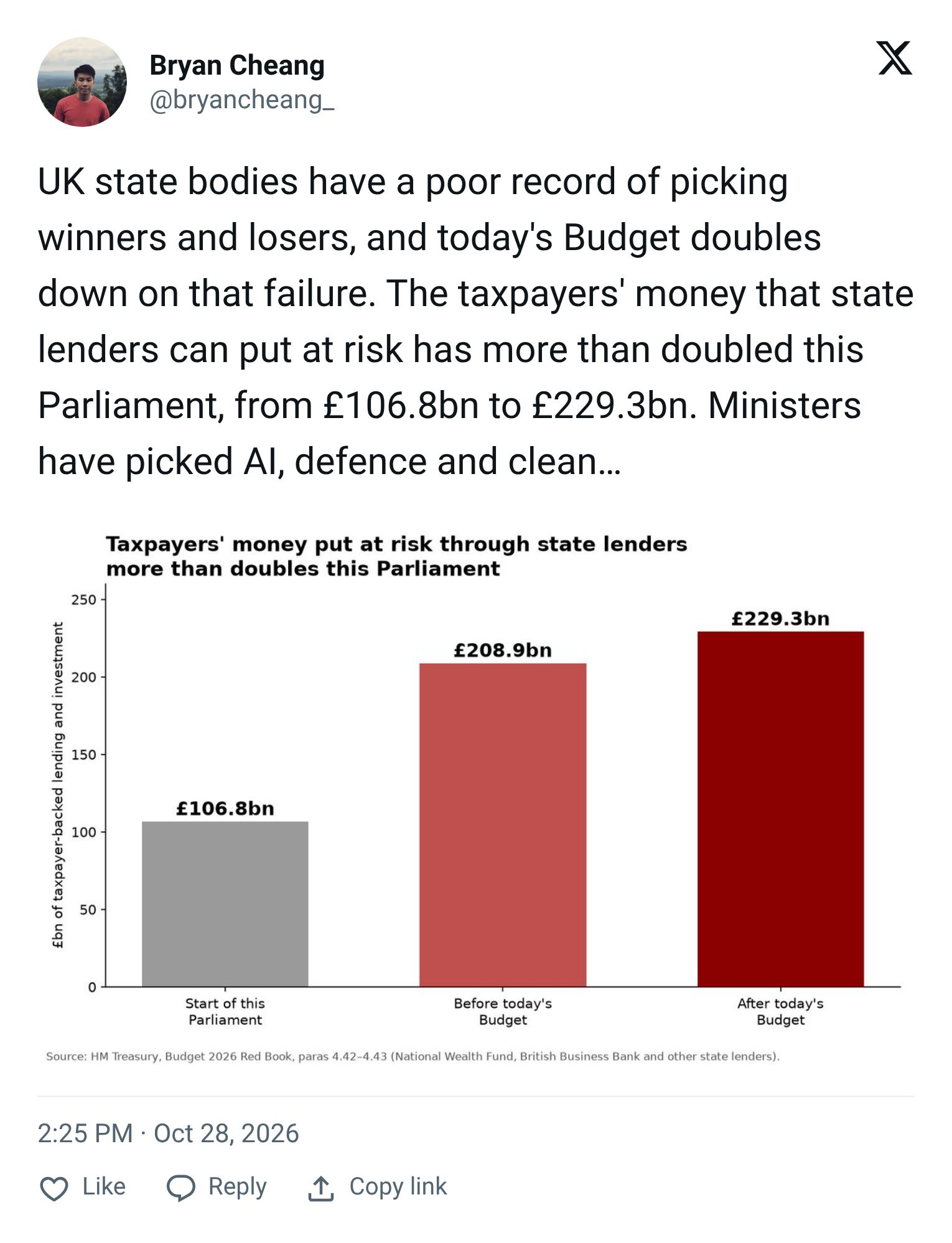
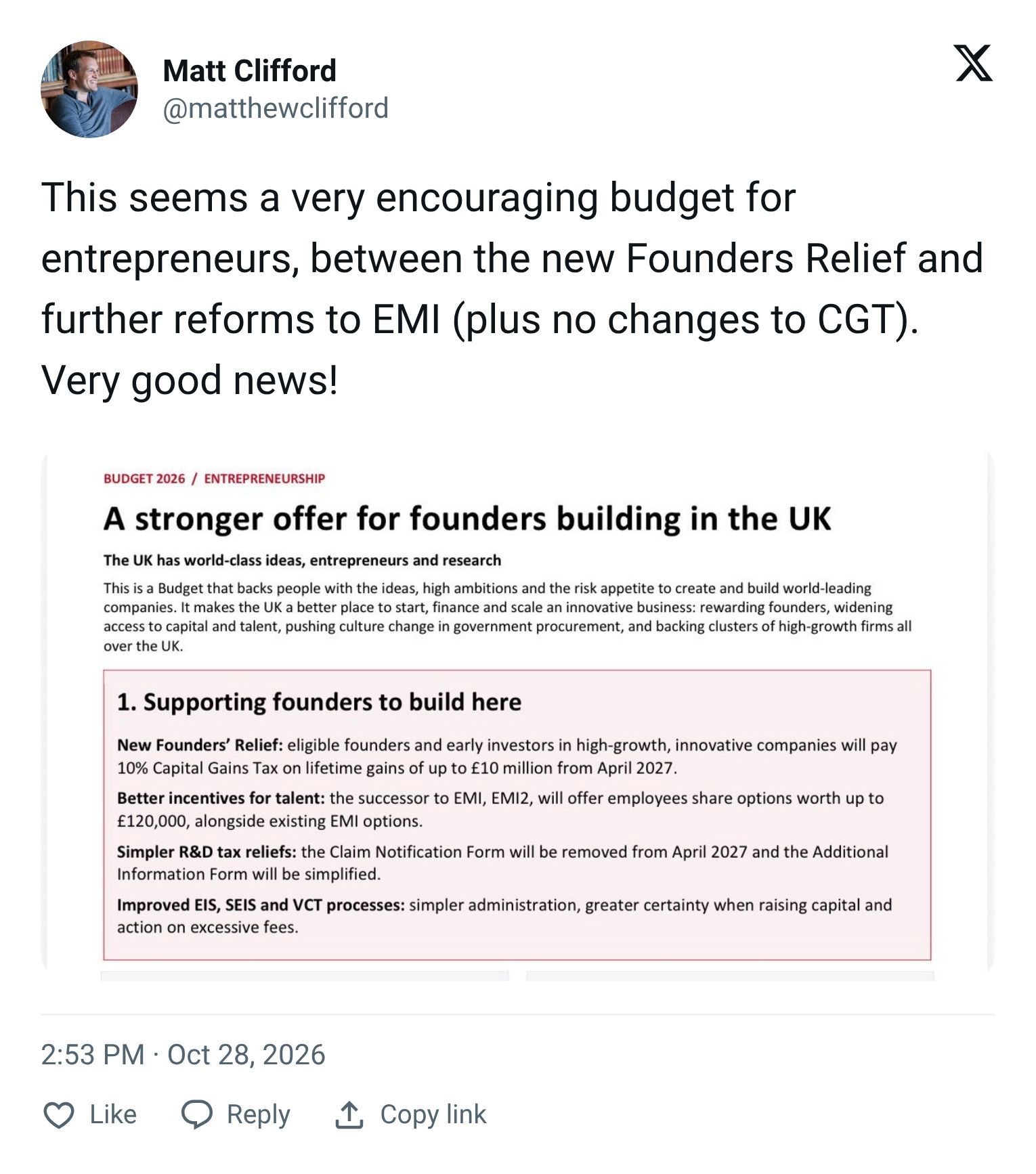
- No CGT increase or Exit tax 👍 This is good news amid ongoing uncertainty. We can forget about this on budget day but our core ask was first do no harm…
- A new ‘Founders Relief’ up to £10m lifetime gains at 10% CGT rate... with a reduction of the BADR threshold to £500k to go with it.
- Expanded share options scheme with EMI2 - replacing CSOP and doubling the limits to £120k.
- £5bn more for the British Business Bank. A top up of cash for the BBB that will be deployed into both equity and, for the first time, venture debt funds too.
- Visa Changes including an expansion of the High Potential Individual Visa.
- £700m+ for AI. Trailed on Saturday we’ve got a package of AI measures that are focused on backing AISI and strengthening resilience but it also backs Sovereign AI with an extra £60m for equity and £80m for procurement.
- Talking Procurement... lots more including a new 'UK supplier' definition and the use of more challenge based procurement.
- A new data centre covenant to push investors to back local communities more in return for faster grid connections, planning and allowing on site power generation. Could be a gamechanger...
- A new young entrepreneurs allowance scheme and more backing for female founders.
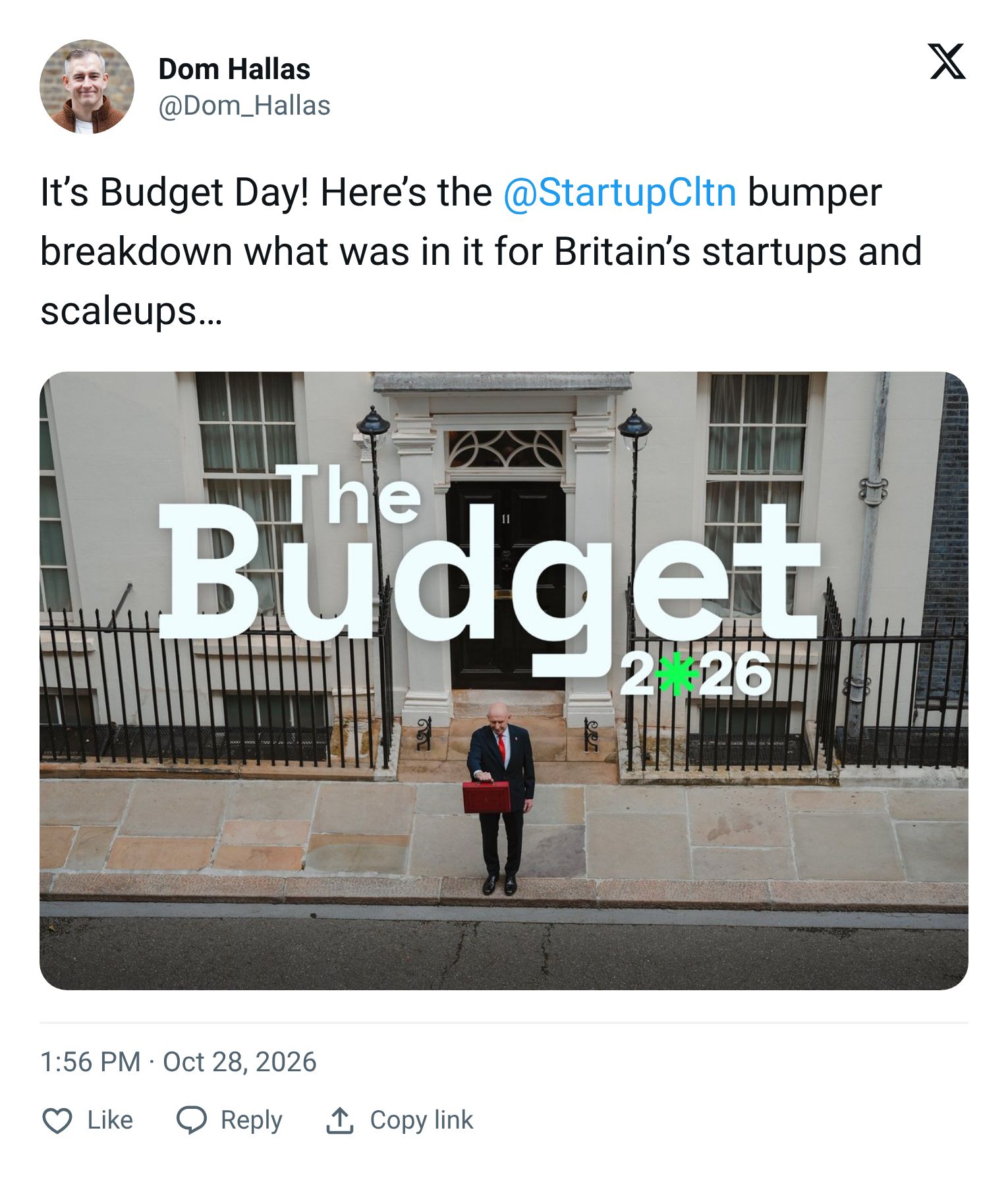
Reaction from the ETN Show (currently live)
LinkedIn Post from Treasury adviser & entrepreneur Alex Depledge:

Comment on LinkedIn from entrepreneur Debbie Woskow:

OTHER RESPONSES:
Brent Hoberman, Co-Founder & Chairman, Founders Forum Group, firstminute capital and Founders Factory. Co-Chair, Enterprise Britain.
“My assessment of the Budget: the direction of travel is right, but there's still a lot of work to be done… Founders Relief: The move today is a positive signal. But the devil will be in the details. It will need to be done right to ensure it's a real draw for entrepreneurs to stay and build here. (And it will have to make up for the cuts to BADR announced today, too!). As a next step why not increase the cap to reward our most successful founders. The effective rate reduces as the exit increases. This really should be paired with Repeat Entrepreneur Relief. The EMI increase helps EMI is a vital tool in our toolkit for attracting and retaining talent but it cuts off at the exact moment a scale-up needs it most….Action on non-competes… needs to be paired with curbs on notice periods to really be effective… [The government] missed a trick by not creating a visa pathway for investors, but we'll continue to push on that front… And finally, I'm celebrating what wasn't in the Budget: an increase in capital gains tax and an exit tax.”
Tim Creswick, Exited Founder | Startup Investor
“Today we got another clear message that the UK government "doesn't get it" when it comes to startups and small businesses. They've taken a benefit that used to motivate thousands of UK founders, and make it one that only a handful will ever receive. It's added work for HMRC, work for companies, work for founders who apply, added to the tax code, and will require new legislation to operate. I cannot find a single benefit that it delivers. In every other way I have discussed, it has made the environment worse. As UK founder for the last 20 years, it's hard not to take it personally.”
• VC investor Phoenix Court has responded with a long piece by Nin Pandit, Managing Partner, Value Creation, Special Projects, and the former Principal Private Secretary to former Prime Minister Keir Starmer. In summary, her view is that although Innovation is already widespread (80% of Britons live in councils containing at least one high-growth company) investment and economic benefits aren’t reaching local communities. Government procurement could unlock growth via public contracts, specialist investment and stronger industrial clusters could help British startups scale. In order words, Britain doesn't necessarily need to create new innovation hubs. It needs to invest in the ones it already has.
• Phillip Burr, Head of Product, Lumai:
"Datacentres are critical to the future of the UK economy. Linking responsible building to faster grid connections is a strong move - it gives developers certainty and communities a stake. The Government also needs to consider how it can better support the tech sector's efforts to make existing data centres work more efficiently - reducing the need for new developments."
• Martin Wrigley MP, Chair of the APPG for UK Innovation, Startups and SMEs, said:
"We are pleased the Treasury has listened and have included several measures in today's Budget that the APPG for UK Innovation Startups and SMEs have been calling for. The £5 billion increase in the British Business Bank's financial capacity, a new venture debt product and plans for an Innovation Marketplace to help innovative businesses win public-sector contracts are all good news. I also welcome the commitment to cut regulatory burdens by 25% and to make R&D tax relief simpler to claim… We also need further reform to close the funding gap… Ministers must make sure public money reaches the British companies that can grow, create jobs and compete around the world.”
• Jonno Evans, Partner at venture capital firm IQ Capital (also a former diplomat and private secretary to two UK prime ministers):
“It was good to see the government announce a series of concrete measures in today's Budget to support entrepreneurship, recognising the vital role that technology and innovation will play in the UK's economic future… Reforms to non-compete arrangements will make it easier for talented individuals to move between companies, launch new ventures and turn innovative ideas into successful businesses. Alongside more generous employee share options and new tax incentives for founders… It was also good to see the government announce plans for a British Data Centre Covenant.”
Eva Barboni, Executive Director, Enterprise Britain shared on a LinkedIn post that there were a few missed opportunities:
“We pushed for the government to create Repeat Entrepreneur Relief, a reduction in capital gains tax for entrepreneurs who reinvest money from an exit in a new British business or fund. This wasn’t included in the Budget, but the new Founders’ Relief highlighted above could still be a win. We urged the government to create a new Growth Visa, which would have attracted global investors to Britain. We know it was on the table, but unfortunately it hasn’t happened…at least not yet. We asked the government to create more incentives for pension providers to invest in Britain. We were glad to hear Healey mention pension fund investment, but we wish there had been a bit more detail on this front.”
Duncan Johnson, CEO of Northern Gritstone, commented:
“While any budget represents a balancing act, the Chancellor’s clear backing for the National Wealth Fund and increased funding for the British Business Bank send a decisive signal that this government is serious about scaling innovation across the UK. Alongside Oxford, Cambridge, and London, the North of England forms an integral part of the UK’s Technology Diamond… Measures like raising the trading allowance to £3,000, funding living costs through the Young Entrepreneurs Allowance, and doubling the British Business Bank’s backing for female-led funds to £200m will widen the talent pool and spark grassroots enterprise. Crucially, while the lowering of the Business Asset Disposal Relief threshold will impact smaller exits, introducing a dedicated 10% ‘Founders’ Relief’ on gains up to £10m directly recognises the disproportionate risks of scaling high-growth firms.”
Tim Mills, Managing Partner at ACF Investors:
“Successful entrepreneurs play a vital role in the UK’s startup ecosystem, not only by building high-growth businesses, but by reinvesting their capital and experience into the next generation of founders. While reducing the BADR limit risks dampening this cycle of investment, balancing these changes with proactive incentives like Founders' Relief will be key to maintaining access to early-stage funding.”
Dame Anne Glover, CEO and Co-founder of deep tech investor Amadeus Capital Partners:
“The Government is right to recognise that Britain must become a more attractive place in which to build and scale an innovative company… The new founders’ relief is welcome, but the reduction in Business Asset Disposal Relief creates a mixed picture for entrepreneurs…. A meaningful capital gains incentive is one of the clearest ways to reward the considerable risk involved in building a high-growth company. Previous relief was a significant benefit for entrepreneurs, but it has been substantially reduced over time. If existing support is being withdrawn or redesigned, the replacement must provide a clear and compelling incentive for founders to build, grow and remain in Britain… The Government has rightly set an ambition to connect British pension savings with British growth, but this Budget did little to turn that ambition into practical change for innovative companies. Voluntary commitments have not moved enough capital into UK venture and growth equity. UK Private Capital’s research found only two legally binding commitments to venture funds from UK defined-contribution default funds, and that overseas pension funds invested around sixteen times more into UK private capital funds than UK schemes did… Policy must explicitly support venture and growth equity, give schemes access to experienced specialist managers and suitable vehicles, and remove the regulatory barriers to building expertise. Without that, British pension capital will continue to fund growth elsewhere.”
Max Buchan, CEO and Founder of British technology company Valarian:
“The Chancellor’s announcement on founders’ relief is important step, giving entrepreneurs more reason to build, grow and reinvest in their businesses here in the UK.”
Kristaps Zips, UK CEO, payabl:
“Access to capital is one of the biggest challenges facing UK fintech firms that are looking to scale and grow. So, today’s £5 billion boost to the British Business Bank's financial capacity is a welcome announcement from the Chancellor. Equally, the £1.4 billion for equity funds backing high-growth businesses, alongside a new venture debt product… Combined with the new tax relief for founders of high-growth, innovative companies, these measures send a positive signal to those choosing to build their businesses in the UK.”
• Anthony Rose, Seedlegals:
“Have you seen the UK government's new Founder Relief proposal? No CGT on your first £10M on an exit. Sweet! But read it in detail. Your company is unlikely to qualify, and you should assume that it will not apply to you. When you start reading it, it looks great. It applies to founders who've got more than 25% equity at any point in the company's life, which probably means if your company's got 3 founders or fewer, you probably qualify. But then it goes into such a convoluted maze of growth, revenue, and R&D requirements that few companies are ultimately going to qualify.”
Michael Harris, Founder and CEO, 89up:
“The reason they put in a headcount figure is previously BADR was used by property empire owners to liquidate individual property portfolios, tax free. It basically became a subsidy for landowners and not actual entrepreneurs, so adding in a criteria for job creation makes sense, especially as the rest of society is paying for this tax break. I think there is a case for Dom Hallas here to argue the 3 criteria should be structured differently, perhaps a higher job creation hurdle, and drop the 25% CAGR (starting at 10m) which seems too high a hurdle for most fast-growing businesses. You could analyse the FT 1000 fastest growing European businesses and I think you'd find very few UK businesses would have hit this hurdle. Also, is it about growth, or creating value to the UK economy, in which case a job creation target makes more sense.”
More reactions from founders:
Chris McMenemy
Founder @ VALO Al Studio
“Devil is in the detail on founders relief! Very few will actually qualify given their wild criteria - must be over £10m turnover, over 15 staff, and at least 2 of 25% CAGR in revenue OR 25% CAGR in headcount OR £1.5m qualifying R&D spend - on top of all the normal qualifying criteria... good on those who manage to qualify 🤡”
Slavomir Hruska
“Startup & Fundraising Consultant and Mentor in Slovakia
10% founders relief up to £10m is a serious signal. Meanwhile in most of CEE founders are still asking why they should build at home and not in London or Delaware 🙃 Governments over here should be taking notes”
Malcolm Gibb
flowio
“I was very sceptical about how business-orientated this government was and whether we'd just see a flat base increase on tax to bring it in-line with income tax but it's rather refreshing. It's a start at least, it does however still leaves a rather uncompetitive economy. Corp tax and employer NI is still significant for start-ups, that plus increasing minimum wage (which is good and bad in itself). On the non-compete ban (which will also include changes to garden leave, notice periods etc.) I welcome this. Coming from someone who previously had to work a 6-month notice period on an iron-clad non-compete.”
Joe Sheffield
Building AI-powered learning
“Hard to call this pro-entrepreneur. The new 10% relief goes to a tiny minority of founders who scale to the very top, while BADR is halved for the many building solid, profitable businesses that will exit for a few million, not tens of millions”
OFFICIAL DOCUMENT SUMMARY (see attached below):
BUDGET 2026 / ENTREPRENEURSHIP
“A stronger offer for founders building in the UK
The UK has world-class ideas, entrepreneurs and research
This is a Budget that backs people with the ideas, high ambitions and the risk appetite to create and build world-leading companies. It makes the UK a better place to start, finance and scale an innovative business: rewarding founders, widening access to capital and talent, pushing culture change in government procurement, and backing clusters of high-growth firms all over the UK.
1. Supporting founders to build here
New Founders’ Relief: eligible founders and early investors in high-growth, innovative companies will pay 10% Capital Gains Tax on lifetime gains of up to £10 million from April 2027.
Better incentives for talent: the successor to EMI, EMI2, will offer employees share options worth up to £120,000, alongside existing EMI options.
Simpler R&D tax reliefs: the Claim Notification Form will be removed from April 2027 and the Additional Information Form will be simplified.
Improved EIS, SEIS and VCT processes: simpler administration, greater certainty when raising capital and action on excessive fees.
2. More capital to scale
• The British Business Bank will have £30.6 billion of financial capacity, including: £1.4 billion of additional capacity to invest through equity funds and £450 million for a new venture debt product.
• Government will continue to work with pension providers and investors to accelerate the deployment of long-term UK capital into innovative, scaling UK businesses.
• Prospective exporters will get wider access to finance through expanded UK Export Finance support.
• An additional £60 million for SovAI to directly invest in the UK's most promising AI companies.
3. Simplifying access to support
• There is a wide range of government support available, but founders can struggle to find and navigate the right offer.
• Scale UK will give high growth businesses a single access point for existing government support.
• Scale UK Connect will give 200 firms across the UK expert advice, investor connections and international opportunities through partners across the UK.
4. Government as a first customer
• A new £15 million AI Challenge Prize to incentivise UK-based innovators to develop AI solutions to major public service challenges.
• £100 million to accelerate robotic-assisted surgery across the NHS.
• A £138 million Quantum Sensing and PNT Procurement Catalyst to accelerate adoption and help UK companies scale.
• An additional £80 million will support SovAI’s R&D Procurement Scheme.
• Intention to appoint an external Chair for BIST's Commercial Innovation Hub.
• Developing an Innovation Marketplace which will launch in Spring 2027.
5. The people founders need to grow
• Government will legislate so that non-compete clauses no longer prevent promising start-ups and scaling firms from hiring talent. We will also shortly consult to understand the wider use of restrictive practices, before setting out a detailed position on all these issues in early 2027 in advance of legislating.
• Further visa reforms will help businesses recruit and retain highly skilled international talent, including by expanding the High Potential Individual visa to graduates of the world’s top 150 universities.
6. Faster routes to market
A new Regulating for Growth Bill will allow innovative products and approaches to be tested and scaled more quickly, with appropriate safeguards.
£1 billion over four years will back priority innovation clusters across the UK.
£25 million for UKRI Venture Doctorates and up to £16 million in proof-of-concept funding will help turn research into commercial products and companies.
Start, Scale, Stay. Further information is set out in the Entrepreneurship in the UK prospectus on GOV.UK
(More detail is attached)


Comment from Startup Coalition, from Dom Hallas on LinkedIn (quoting directly)